


They may not need to ban old cars outright. Instead, they’ll just kill them off quietly – by poisoning them internally.
With ethanol.
Modern cars – cars built since the early ’90s – can stomach the stuff . They have engines designed to deal with corrosive, ethanol-doctored “gas” – and peripheral systems (hoses, seals, o-rings, lines, etc.) made to withstand it. Being computer controlled, they can also adjust themselves to deal with ethanol-laced gas. They may not get the best mileage they’re capable of delivering – because ethanol is less energy dense than gasoline – but at least they run ok.
But with older cars – cars built before the early ’90s, before widespread use of ethanol-doctored fuel – you’ve got two problems. One of them is relatively minor – and easily fixed.
The other’s more serious – and not easily (or inexpensively) fixed.
The minor problem relates to the older (pre-early ’80s) car’s static engine operating parameters. Meaning, they can’t self-adjust like a modern car’s computer-controlled engine to compensate for different fuel type and quality. They’re mechanically set to run a given air-fuel ratio, ignition timing and so on – all assuming a given type of fuel. In the case of of early ’80s and older cars, that means regular unleaded gas – not mostly gas and 10 (or 15 or 85 ) percent ethanol.
If the type/quality of fuel changes, but the engine isn’t adjusted to compensate, it won’t run as well it should until it is adjusted – or it’s fed the original type of fuel it was designed to burn. If it’s not adjusted, what typically happens is the engine runs lean when it is fed ethanol-laced fuels. One result of that is it will run hotter. This was precisely what was intended – openly – when “oxygnates” such as ethanol and MTBE were added to gasoline beginning in the late ’80s and early ’90s. It was a way to lower the tailpipe exhaust emissions of pre-computer-controlled car engines – because they could not adjust themselves and in this way, the fuel altered the operating characteristics (and exhaust byproducts) of the engines in those cars. 
The downside – in addition to the noticeable reduction in gas mileage that resulted – was that these older engines were often harder to start, would not idle as smoothly as they did previously, tended to stall more – and lost some horsepower, in addition to the drop in gas mileage. An engine that’s made to run hotter than it was designed to run will also tend to wear out faster.
The fix for this is fairly easy. You (or your mechanic) simply adjust the carburetor to run richer, alter the ignition timing – and so on. Now the engine will run ok – even though it probably won’t give you the gas mileage it otherwise would have – just like any new car force-fed ethanol.
Once computer-controlled engines came into widespread use beginning in the mid-late 1980s, the need for ethanol-oxygenates as a form of emissions control vanished – because these cars would automatically adjust for the leaner fuel they were being fed. Of course, the use of ethanol was not discontinued. It was expanded. Today, most “gas” is actually 10 percent ethanol (vs. 5 or so at first) and there is talk of upping the ratio to 15 percent ethanol. And that poses a serious threat to the well-being older (pre-’80s) vehicles.
Such vehicles are vulnerable to alcohol-caused fuel system corrosion (think gas tanks, steel fuel lines) as well as potentially catastrophic fires resulting from seepage around seals and from hoses/rubber diaphragms (as in mechanical fuel pumps) not made to withstand high-alcohol-content fuels. The only fix is to physically replace all the affected parts with new parts made to handle alcohol-heavy fuel. This can involve a great deal of expense – enough in some cases to make it not worth doing. A new gas tank, steel lines, fuel pump, flexible hoses and rebuild of the carburetor with new gaskets, floats, power piston, etc. can involve $1,000 or more just for the parts – and if you have to pay someones else to install them, much more than that.
The main effect, unintentional or not, will be (has been) the accelerated retirement of not-yet-restored older cars still being used for regular transportation. Or just sitting (really bad news if there’s alcohol-laced “gas” in their systems). The more ethanol they put in “gas” – the worse this will get. Especially if “gas” shortly becomes 15 percent ethanol – as seems likely.
Restored classic cars will have been updated with the new, alcohol-friendly parts because that’s all they sell now. But the not-yet-restored ones will deteriorate more rapidly, which will mean they’ll get thrown away sooner. This means fewer “project cars” and “parts cars” available – and higher prices for the limited pool of already restored/well-kept older cars, just as Uncle Sucker’s Cash for Clunkers has markedly driven up the price of clean late model used cars. 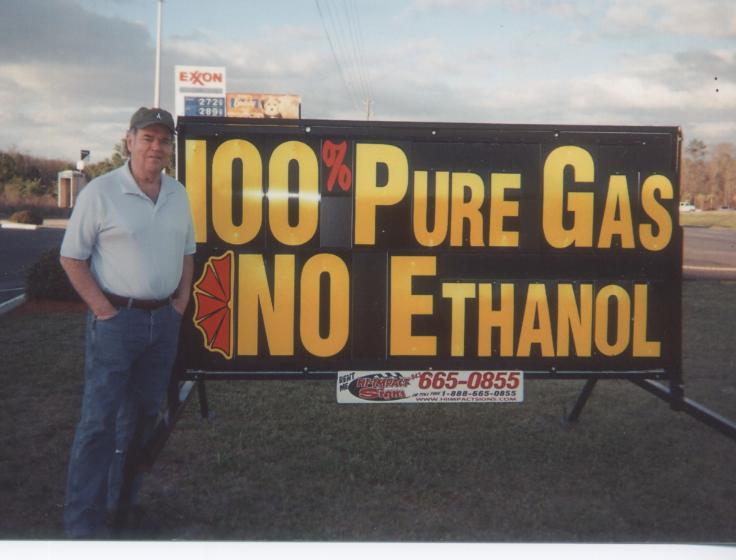
So, we’re facing a much more subtle end-run assault on the pre-computer, pre-“safety” automobile than getting laws passed that directly target them – such as laws requiring they meet current emissions standards or that they be retrofitted with air bags and computers and all the rest of it. Just kill them off, quietly – by attrition.
The Clovers who hate old cars may have taken a lesson from the Clovers who hate firearms. Rather than ban guns, they are shifting their efforts to bans on ammo.
A gun without ammo is as useless as an old car with an ethanol-rotted engine/fuel system.
Mission accomplished.
Throw it in the Woods?







Down here in sunny Florida, I use the pure gas website but I’ve noticed that recently, anyway, new c-stores with gas pumps have one pump with a non-ethanol or “mogas” product available. Sometimes labeled “Off Road Gas” like “Off road Diesel”.
Only difference, you pay the road tax on ALL gasoline.
Another interesting website, AirNav (linked below) gives locations for airports.
http://www.airnav.com/fuel/local.html
There you can buy 100 octane low lead avgas which runs GREAT in 60’s cars and trucks.
Here in Florida you can tell them you need a few 5 gallon cans or a 55 gallon drum for your airboat. Lots of airboats are equipped with small aircraft engines so this makes sense. I haven’t had any problems with that explanation yet.
A few years ago I had a ’66 GMC 3/4 ton truck with the E-305 V6 engine.
I’d put 5 gallons of avgas in and fill it the rest of the way with 93 octane mogas and had about what it was built to run on. After the minute or so it took for the new fuel to get to the engine, I could feel the difference.
I haven’t noticed any dye I the mogas like they put in red diesel yet but it could be coming.
This is an absolute crock, and non factual. Ethanol does not harm any PARt of a vehicle that is newer than 1995.
I have a 2006 Hyundai, non flex fuel vehicle that I have run on 30% ethanol or higher for 110,000 miles. Runs like a top and only ever replaced brakes and tires.
Same with my 2009 Sonata.
This is exactly the kind of propaganda and lies that sheeple believe, and the petroleum industry wants it to continue. They want you to use only their product, and lies mean nothing to them. THEY know ethanol is fine for cars, and up to 30% for all cars has been tested and proven. The oil lobby bought our politicians.
As opposed to factual crocks, Fred?
Look, if it’s a “crock,” then why do the manufacturers of cars – including Hyundai – explicitly state that using more than 10 percent ethanol will cause damage to the vehicle (and void the warranty) if it’s not set up for flex-fuel? Why do manufacturers of power equipment (Stihl, for example) explicitly state the same things?
The physical properties of ethanol (alcohol) are not a matter of opinion, Fred.
It is corrosive – and thus, it is damaging to components not designed to withstand high concentrations of alcohol. It does attract moisture – which is an issue in cars (and power equipment) not made to deal with that. It does contain less energy per volume than pure gas – which means you need to burn more ethanol or ethanol-laced gas to go the same distance (vs. using pure gas).
Facts, Fred. Not debatable. Not opinion. Facts.
You make assertions – and accuse me of not dealing in facts. Well, I just provided the facts.
Is ethanol all bad? No, of course not. Among the positives, its use allows high compression ratios, which is good for both power and economy. And it can be made in a way that’s economically reasonable. Unfortunately, that’s not how it’s made here in the US.
PS: The longevity of your brakes and tires is relevant exactly how?
The big agra lobby wants you to use ethanol. They lie to us on food, so why not fuel?
Big oil shouldn’t have a problem with ethanol. Making the ethanol the way it is done for most of it in the USA requires the use of more of big oil’s products, not less. The added costs for putting it in the gasoline they just pass on.
You do realize this article talks about the majority of damage being done to older cars that can’t handle the ethanol-laced gas, right? It explicitly says at the beginning of the article that cars newer than the early 90’s are mostly resistant to damage from ethanol, while cars built before then aren’t so lucky. Was your 2006 Hyundai built in/before the 80’s? What about your 2009 Sonata? So your claims concerning your cars running well are mostly irrelevant to this article.
Very good write-up, and soooo true!
One thing that I did not see mentioned about the problems of today’s gasoline:
Ethanol is very hydro-philic. That is: I draws in a lot of water through vapor, humidity, etc. from the air.
A really big problem with the mostly-Ethanol and other “additive”-laden fuels is the fact that our gas is effectively “watered-down” in the process. There is a lot of water added to our gasoline that is able to remain “in solution” because of the additives which act like “surfactants” (in a way like soap works to help warm water flush away greases and oils during washing).
If you live in an area that has seasonal extremes in temperature (like much of the Northern half of the U.S.A. – Hot in the Summer, cold in the Winter), these ups and downs in temperatures (especially in the Equinoxes time of year between the daytime temperatures and nighttime temperatures) will cause even more humidity to condense in your gas tanks. You also must consider the water vapor that comes out the exhaust manifold through your exhaust system. I have had two cars that need to have their entire exhaust piping and mufflers replaced due to being rusted out! (I live in an area that does not use salts for de-icing the roads like many of the North-Eastern areas of the U.S.A. used to!)
So, the amount of water that exists in our fuels is also a major problem!
The petroleum companies also deliberately “water-down” the gasolines so that they can sell more of it, at ever-inflating prices! THAT is why you see all of these additives to the fuels: To allow them to water-down/adulterate the fuels (think: all the “different grades” of gasoline you see at the pump). The petroleum companies are ALSO trying to force out of existence the older cars, by causing them to rust out with all of the added water and chemical additives to the fuels. It is not all Ethanol, but a combination of all of the above-mentioned that are pushing our older cars into obsolescence!
” Just my observations as an experienced car-owner! ”
– Jim S.
Thanks, Jim!
Excellent additions, too.
I replaced all the fuel lines in my antique car with stainless. I also use the “marine” grade Sta-Bil, which I highly recommend.
The main thing is to not let anything sit with fuel in it for an extended period of time. I try to run all my stuff at least twice a month. This keeps fresh(er) fuel in the carbs and that helps avoid crap building up inside them during downtimes.
What if you leave your gas cap off? Will the alcohol evaporate because it is more volatile than gasoline?
Hi Evan,
Well, I don’t about that – but probably the “check engine” light will come on (because the evaporative emissions system requires the cap to be secure) and you are inviting moisture to get into the tank.
So, those are two good reasons to make sure the cap is on and properly secured!
Storing vehicles with the tires off the ground helps, as it prevents separation and moisture damage, and flat spots. Older drivers remember when getting 25K miles on a tire was a great thing but now tires routinely give many times that. Tires are much better than they used to be, but they don’t last forever. Think of tires as an expendable time dated commodity. An old tractor tire will last a long time because it is built to go slow and not get hot and flex like a highway tire. Failure of a tractor tire is an inconvenience, failure of the left front tire on your motorhome could be a catastrophe. Watch for sudden new noises and vibrations when driving, it could be a new bulge or separation in a tire, the precursor of a blowout. Check with a gloved hand for tire bulges, it works.
First let me say I’m not associated with any tire company or sales of tires. Tires don’t last for ever. They age when exposed to air, heat, and sunlight. IMO a 10 year old car tire is junk, no matter what the tread looks like, or if they have even been mounted on a wheel. To tell a tire’s age, look next to the DOT impression nearby will be a number, the first two digits are the week of manufacture, and the next two the year; thus 4510 is the 45th week of 2010. I replace tires after 5 years, even if they ‘look good’. I tire with bulges or bumps are separated internally and are a blowout waiting to happen. Make sure your motorhome tires are rated for the load they are carrying, and don’t hit curbs, potholes, or road debris which will cause such damage.
The Kid, that’s good advice but make sure you check it before the tire is mounted on your wheel. I have seen 6 year old tires that had been in stock at Sears. When tires get old enough to separate, and that varies a great deal from one manufacturer to another as well as differing products each one produces, the entire set needs to be chunked. A friend had an ’80 Thunderbird with Firestone 721’s, one of the worst tires to ever hit the market. He had a blowout one day a couple miles from town so he gets the spare out that had never been used, puts it on and gets another mile before it too blows out. Needless to say he had to get a new set and didn’t get Firestone’s. Firestone has colluded with Ford for over a century to rid itself of bad tires, something the company does on a far wider scale than any company I’m aware of. Of course, Harvey and Henry being brothers in law could explain that entire collusion.
Hi Eric,
I wonder if there is also a kind of obsolesence built into radial tires? Most of mine come apart or get bumpy long before the tread wears out. I am 64, and don’t remember having that problem with bias ply tires. I still have sets on little-used vehicles and equipment that are still good, all 30 to 40 years old, with 30 to 55 pounds of pressure. They are: 5.60-15, 7.00-14.5MH, 6.00-16, and 7.00-18. The ones on my ’58 MF tractor could be original. they have sidewall chunks missing and little tread, but they are round and work fine!
I have had radials go bad at less than 2 years old. 5 of 6 on my motorhome failed before they were 8 years old, even though there was still 75% tread and no visible cracks or defects. I had 2 spares explode in the trunk of my Chevelle. They were about 15 years old, but were not even on the ground!
Since I drive so little in retirement, I wonder if I should go back to bias-ply?
Pat
Where would you find any new stock of bias-ply tires for passenger cars? Never mind that suspensions have been tuned for radial tires for decades.
Bias ply tires for passenger cars were more susceptible to flat spots and such that radial tires. I’ve only seen tread separation on one radial tire and it was about 17 years at the time. (original full size spare) Oddly though I have the original bias-ply spare for my ’73 although it’s spent the entire time I’ve owned it indoors and not in the car’s trunk. Not sure that’s a fair to compare it.
I wouldn’t compare equipment tires though. They are built with a whole different performance in mind. My guess is some sort of temperature related decay got at your radials. Something the equipment tires were built withstand or there’s some additive in the rubber, etc that has since been banned. The kind of failures you are describing sounds more like a failure of the rubber or the manufacturing not difference between bias ply and radial.
As for buying bias ply tires I believe some are made for to be factory correct for show car restorations and the like.
I’m not so worried about the effects of burning E10 or even E15 in my Shark, but I think it’s downright despicable that the difference in price between real gas and corn liquor is maybe a buck a gallon while the difference in fuel economy is a nearly a factor of two.
E10 cuts mileage by about 40% even if it doesn’t rot your rubber, but the industry depends on consumers not paying attention. Not only are farmers in Nebraska subsidized to grow corn for car whiskey, the stuff is overpriced by 2X!
The old “screwed blue and tattooed motto comes to mind!
So Eric, you have a TA? We need to get together sometime and burn some rubber!
It was very noticeable when they first began doing it back in the ’80s because it was seasonal. The “oxygenated” fuel came online in winter, and people noticed the obvious sudden drop in their fuel economy. Now it’s year-round, so people don’t notice – especially those who don’t remember.
There is another option; you can convert older carburetor and non computerized cars to propane also known as LPG. I have a 1971Ford truck that runs just fine on the stuff. The fuel doesn’t go bad sitting in the tank, and is available almost everywhere. It is 105 octane, but has less energy per gallon than gasoline. This isn’t a fix for everyone, but those who can do the research and have the room and money to install the system will be glad they did. I installed the system on my truck after the 1973 gas crisis. The propane requires some engine mods, but will work very smoothly. I too wish I could acquire some real gas for my other vehicles. If money is no object, try small airport fueling facilities, where the gasoline is prohibited from having alcohol. They may not sell it to you without a plane.
The fictional Hank Hill will love ya. More “Propane and Propane accessories” to sell.
For my mid 80’s hoopties I don’t bother or really worry, they run anyway. But I still have a 65 mustang all original with a straight six. Less than 90 thousand miles on it. I bought it from the origanal owner in Ca. Then I have a 72 VW Squarback. My surfmobile. ($700 and it came with an ounce from Humblolt County) I run farm gas in them. Yep, regular leaded. It’s colored for some dumb reason. I thought about adding green food coloring for St. Paddy’s day. Not exactly muscle cars like I used to own, but they are family and I don’t want them to die.
I have 57 chevy thats been on the road for 10 years with 540”bb areo quip lines new alluminum tank no problelems yet
I’m from Iowa and pretty much every gas station here sells both regular gas and ethanol blend. Also, ethanol is always cheaper than gas. Usually by enough to negate the loss of BTUs.
Bottom line, if you can get regular gas in every town in Iowa (the heart of ethanol country) it is not the corn lobby killing your cars. It is the EPA mandating its use because of air pollution.
Phillip wrote, “I’m from Iowa and pretty much every gas station here sells both regular gas and ethanol blend.”
Uh-huh, I don’t think so.
Regular gas is as rare as all get out in Iowa cities.
Pretty much every gas station here sells nothing else except the ethanol blend.
In Jefferson, Henry, and Wappelo counties every gas station I’ve been to has 87 octane regular and 89 ethanol and 91 (usually) ethanol gas. So if you are looking for premium you are correct, its harder to find. I’ve bought regular for my ’89 car for years.
My Brother is currently driving a 1984 Lincoln. When idling it will sometimes just die, so Eric’s spot on with E gas.
E gas is also one of the reasons that we are paying so much for gasoline; $4.30 here in Ventura County CA. E Gas can’t be shipped in the pipeline so it must be transported to the gasoline storage and is added to our gas at the last moment. What’s worse is that the refiners have 50 some different blends to contend with thanks to stupid agenda based EPA.
Not only that, but I have not heard a major broadcaster tie the expiration of the ethanol subsidy to the increased price of gasoline. That had to raise the cost to the refinery blends. Too busy trying to put all the blame on the big, rapacious, oil companies.
Our small Utah town used to have two stations that sold gas (not gasahol), but it soon became to expensive to get it because the source was too far away. Now I have no choice but to put government-controlled fuel in my vehicles. During the winter, when “winter blends” replaced the “summer blends”, I lost 5-6 miles to the gallon. Damn our meddlesome government.
I wonder how many have read the warranty terms on even their “new” cars. Our 2010 Hyundai, for instance, voids the warranty if greater than 10% ethanol is used. Will the government pick up the difference if they force me to use 15%. Sure they will! (Then again, if it advances our devotion to Socialism, maybe they will.)
Lobby #147, the corn lobby, is trying to kill cars. Worse, it is part of a swarm of lobbies trying to kill freedom. These lobbies exist to spread dysgenics. Dysgenics is the breeding of a new society where the dumbest and least fit survive. The more the world’s people degenerate in ability and intelligence, the better the lobbyists like it.
If we were not so stupefied, Libertarians would live in energy-cyclic sub-developments. All sewage, garbage, dead plants, animals, and people would go into the energy facility and emerge as fuel. Leftovers from a meal, yard trimmings, feces, urine, dead animals and relatives all need to go into some type of underground tube to a subterranean place where all the glucose can be anaerobically processed back into petroleum. It’s landfills and cemeteries that lead us into slavery and extirpation. The answer is Soylent Oil.
A proprietary full spectrum system of more efficient energy redox is all the advantage that’s needed to allow Libertarians and Voluntarians to grow faster and healthier in isolation from the hideous, statist, and semi-human masses. We will succeed and thrive, and accept only those outsiders that practice non-aggression and have individual goals and objectives.
TPTB will fail to breed or survive. There are limited third-worlders they can develop and live off of. Their inner city captives can only be degraded so far, diminishing returns will come into play. A point is reached where the effort to control incompetents costs more than the value of the goods and services they can produce. They will lose the battle to attract outsiders to the more prolific and more tolerant Libertarians and Voluntarians.
In the current system of central banking and central command, a type of unison and enslavability is demanded and required. Let’s not attempt to contradict or improve this unspeakable madness. Let’s build hidden arks, private vineyard, and secret coops, using mutually developed technologies and protocols that are post-national, post-racial, post-institutional, post-societal, post-codification, post-dominion, and of course post-cloverian.
Tor, you always make my day!
Tor you are mostly, well, nuts!
So says the anthromorphically formed King’s wheat, amberly wavering and saying “scuse me, while I kiss the scythe.”
I pledge allegiance only to myself, one man, indehiscent, with ownership and autonomy over what is mine.
http://www.youtube.com/watch?v=D0Md7aIudZE
Are you the type who cowers beneath a lethal tyrant like Jere Wood J.D.; Mayor for life of Roswell, GA.
Are you the type that can’t see it is the official vultures that need to be tarred and feathered, not the pleasant and quirky freeman like Chicken Man Andrew Wordes, dead at 53 from the decapitating blades of Big Brother Bullies.
http://www.youtube.com/watch?v=D0Md7aIudZE&feature=player_detailpage
Pardon me, Tor – But I must concur, you frequently sound certifiable. 😉
Poor Kentek thinks it’s a BAD thing, but how else does one avoid taking a weedwhacker to clover?
Insanity: The only SANE solution – to an INsane situation!
And
There is a thin line between insanity and genius. I dance across it.
My only hope is the loonies running the asylum never find out how frighteningly sane (and stupid) they are, and collapse the whole burning pile of feces on their heads. The rest of us will benefit immediatley, and long-term. And I’ll see you on that other ide. 😉
A couple of years ago my ’85 Dodge van mysteriously would gradually die on the road, only to revive if I let it sit for a minute or two. Took it in twice to the shop, and the mechanics could find nothing wrong. Then back on the road and HUMmmmm gradual death again. I considered scrapping this perfectly serviceable vehicle until I discovered, by pure happenstance, that the place I gassed up regularly had been selling ethanol gas for a year without so labeling the pumps.
I removed the gas tank, had it professionally cleaned, put it back on and voila! fuel problem solved. Apparently the ethanol (a great solvent) had loosened all the crap in the tank which then got sucked up the uptake tube, then when the engine died the lack of suction let the crap settle back down. This ethanol also explains why my snowblower started running poorly–the mechanic who looked at found the float bowl gas (and showed it to me) chunky with bits of fuel line. Ethanol did a number on this 14-year-old blower as well as my van.
I live in the heart of corn-to-ethanol country and have debated the ethanol advocates in local newspapers. What a load of crap they spin for the rubes, not the least of which is that ethanol helps us be independent of imported oil. They seem to forget that it takes as much oil to make their damned swill as it displaces. Talk about zero sum accounting.
Hi Ross,
Yup – and as you’ve personally experienced, in addition to paying at the pump (and via your tax dollars) we also pay in the form of new (and higher) maintenance/repair costs.
The corn con is right up there with Social Security!
The most common cause would be rateled to the check engine light being on. Once the check engine light is illuminated the computer compensates for the failing part/sensor and uses a preset number(parameter) to allow the engine to still operate. These preset parameters will allow the engine to run but will not be able to give you the good fuel mileage you were used to getting when everything was working properly.
How can you tell if it has the alcohol mix if they do not post it on the pump?
I thought that was the law in Ohio. They have the ethanol 85 coming from a different pump than the regular unleaded 87. It is marked and it is cheaper.
I thought we were getting regular unleaded for the higher price.
One thing about the old fashioned mechanical carbs is you can adjust all sorts of things on it. You can even adjust the engine to run on kerosene. It was done in WWWII by engineers fed up with rationing. No one thought to ration kerosene. The difference was the octane rating.
The law may be different in Ohio – here in VA, all the pumps are labeled. It’ll say, “this product contains 10 percent ethanol” or something along those lines.
Has anyone sued them for damages to their vehicle?
EPA wrote, “… If it’s not adjusted, what typically happens is the engine runs lean when it is fed ethanol-laced fuels. One result of that is it will run hotter. … ”
Gosh, so maybe that’s why my 1960’s car overheated and cracked a chunk in-between the piston cylinder rings? I always wondered about that.
[Afterwards, the difference between cylinders was so slight, when checking with a compression tester, it was almost un-noticeable… until I rebuilt it, and as I pulled the cylinder out, chunks started falling out.]
If so, I wonder how many other People got burned this way, and had no idea? Excuse me while I mutter, Bastards!
Also, the sub-headline for this article on LRC was,
“The Corn Conspiracy
To kill your older car.”
I got a LOl out of that. … But then I got to thinking as I read this article,… and it hurt some.
Another also, “E.P.A.” ericpetersautos, ha! I get a kick out of that too. – I like the EPA website! – Never thought I’d write that.
However; this wasn’t fun to read, “The only fix is to physically replace all the affected parts with new parts made to handle alcohol-heavy fuel. … can involve $1,000 or more just for the parts”
I was thinking this would put a damper on the idea of buying a Bug. Thankfully there is One gas station in town which sells real gas. I’m guessing that’s the next target for the Clovers?
BTW this is the only gas which stops the exhaust from my better halfs 2000-ish from smelling like a skunk,… usually. [I still haven’t figured that one out.]
This also means a Bug is not a good bug out vehicle unless it’s been updated?
Yet another also, the pure-gas website is great, but it doesn’t have all the stations on it, well, at least mine isn’t on it.
Psft, when I taught myself how to work on cars I thought I was a bad mechanic, I did everything by the book, I didn’t have anyone to tell me, “Hey, simply adjust the carburetor to run richer, alter the ignition timing – and so on” I thought it was my fault “… these older engines were often harder to start, would not idle as smoothly as they did previously, tended to stall more…”
I chalked it up to a learning experience at the time.
One I Shouldn’t Have Had To Go Through! … Excuse me while I mutter, Bastards!
And,… dang it, the busted out Bug I was looking at which has sat in a shed for awhile might be more beat up than I anticipated due to it sitting with a tank full of ethanol. This means I will have to go back and consider the more expensive currently running Bug I almost bought,… or lower my offering price for the cheaper one.
This website is getting to be like this guy I used to be around now and then,… every time I was with him I learn something. Only, you’re a freedomista and not some clueless head-stuck-in-the-sand, go-along-to-get-along communist type.
Whew, that was a bit long winded, sorry for blog hogging.
Clark,
The pure-gas.org website is user supported; the reason your gas station wasn’t on it is because you didn’t add it. If that gas station still sells ethanol-free gas, kindly add it to the pure-gas.org website.
In Brazil, it’s mandatory for all fuel to conatin at least 25% ethanol. While still another disgusting Govt monopoly, it at least makes sense given their tropical climate and advanced distillation facilities.
In the US, it’s a just a corny boondoggle. It actually takes a gallon of ethanol to make a gallon of ethanol. Why not bottle up the stuff as Bedrock Lightning and propel our cars Flintstones style? There’ll be less emissions that way. Bring Cruella Michelle’s Just Move to a whole new level.
http://www.youtube.com/watch?v=j9QQcP_Y1II&feature=player_detailpage
I remember reading something, back in my American-only hot rod days, about how an engine needs about double the flow rate on alcohol as it does running straight gasoline.
If that’s still true, that means fuel economy gets cut in half.
Even if not strictly a 2:1 ratio, an alcohol engine needs more fuel mass than a petroleum engine for the same power.
Big problem, unless this inspires us to become a nation of moonshiners once again…
I have a buddy that lives in Brazil. Met him back in college, he’s a cool dood. Anyhow, he has an old Bel Air. My man runs like 27 psi of boost on a straight six. I was like like,”dood where is our intercooler?” He told me he don’t need that shit, he’s running alcohol. Anyhow, he has a blown engine now. It took the abuse for a long time. I’ll find his youtube videos and post some.
If I remember correctly, switching to 100% alcohol requires
jets that are 40% larger.
One gallon of pure unleaded gasoline contains about 114,900 BTUs. One gallon of ethanol contains about 76,500 BTUs. That explains some of the difference in MPG between the two fuels.
Changing things like the fuel system materials, the air-fuel ratio, and the ignition timing can make a car designed for gasoline at least drivable on gasohol. However, the engine would not be as thermally efficient on gasohol as it would be on pure gas. For example, an engine that is 30% thermally efficient on pure gasoline may only be 25% thermally efficient or less on E85.
Ethanol has different vaporization and burning characteristics than gasoline. To make an engine as thermally efficient on ethanol as what it is on gas, many more modifications would have to be made. The compression ratio would have to be higher, the combustion chamber would have to be modified to better mix the fuel and the air and the fuel injection system would have to operate at a higher pressure to better atomize the fuel. Once these modifications are made, the engine wouldn’t run so well on gas anymore.
The political terrorists don’t have to outlaw automobiles directly…They will just outlaw…say…round tires. They are slowly regulating the automobile out of existence.
The bratty and unthinking little psychopaths (aka,Clovers) want everyone to live in cities and ride public transportation. As a rational thinking adult, you do NOT want to be among the parasite Clovers in the cities! They will use political terrorism to force you to be their milkcow…Plus – Pedestrians are assholes and they stink.
Finding non-ethanol fuel can be a pain in the ass. Here’s a site that tracks locations of sellers
http://pure-gas.org/index.jsp?stateprov=FL
When my stable had little British roadsters in the inventory, I made it a point to keep a stock of real gas on hand via a nice stash of 5 litre NATO fuel cans. Keeping these cans filled required a somewhat lengthy drive to malt liquor country. This was and is the only station that sells real gas. I made it a point to pay in cash, natch; there was no telling what sort of security protocols were (or weren’t) in place for card-based transactions.
Once, in a pinch, I needed to fill the tank when the cans were empty (I was showing the car that morning). I knowingly filled up with 91 octane E10. On a lark, I drove through most of the tank before refilling. The car didn’t seem any worse for wear, but that was the limit of my desire to experiment with corn liquor. Feh!
BTW, I took home “Best Import” on that drizzly May morning. Yay for me. 🙂
Luckily for us, real unleaded is available in town – about 15 miles down the road. It costs about 10 cents more per gallon, but this is a net wash given the superior fuel economy. But the main reason I buy it – for my older vehicles – is storage. It takes me a few months, sometimes more, to burn through a tank of gas in my old muscle car. I’d rather not have E10 sitting in the tank/lines during that time. Ditto some of the lightly used old bikes.
There are parts available, such as hoses and fittings from Aeroquip and Earl’s, pressure regulators, diaphragms, etc., that are designed to handle just about any liquid you want to run through them. Just check out a Summit or Jeg’s catalog.
And guys convert engines to run alcohol fuels all the time, at least for racing.
Why not do an alcohol conversion on an older car, If that’s the only fuel available?
It’s definitely doable ( did it when I rebuilt my old Pontiac’s drivetrain – including alcohol-friendly (tolerant, anyhow) needle and seat/accelerator pump, etc. in the carburetor – plus new stainless steel fuel lines, etc.). The big issue is the money. For me/the TA, it wasn’t am issue because I love the car, want to keep the car – and have the means to do what’s needed. But for a person without the means – or some not restored “old car” just sitting in someone’s backyard… it’s gonna be a different story….
I have been running my 51 Pontiac on the cheapest gas available since 1979. In Illinois, that means gas with ethanol in it. I have not had any problems. I did change to an electric fuel pump, and bypassed the mechanical pump, but that was because it took so much starter cranking to get gas up to the carb to get it started. It fires instantly now, well, as instantly as 6 volts fires.
Money might not necessarily be an issue.
As you said, you love your TA, and you’re not the only one who’d go to such lengths to keep your baby running.
When I found out that my $600 Thunderbird Super Coupe needed new power steering lines, I went to Ford and found out they were like $300.
Bollocks, piss on that!, I said in my best Cockney soccer hooligan accent.
Anyway, I got some braided teflon line and a few Aeroquip fittings and spent a Saturday afternoon making new lines.
Without having ever worked with braided lines and fittings before and for about one-third of what Ford wanted.
Car worked great with nary a leak, until a year later when I wasted the transmission trying to rock it out of a Chicago snowbank on bald tires.
I miss that piece of junk…
Memories! Back in the ’80s, the T-Bird Super Coupe was a huge hit – saw them all the time. But they seem to have just disappeared. It’s probably been ten years since I last saw one on the road…
If your ’51’s fuel system rubber has been replaced in the last 20-30 years it’s probably ethanol compatible. This leaves only dealing with the steel.
I had the same cranking issue on my ’73 Ford (when hot) when RFG came into effect. I have a clear inline fuel filter and what would happen is as soon as the engine would be turned off the fuel would boil in the lines. Car wouldn’t start until all the vapor was pushed out. When it got bad I would disconnect the fuel line and let it vent to the air. Eventually the RFG formulation improved and the problem just went away. Higher fuel pressures with fuel injection prevented it on more modern cars. Other than that it has been largely ok, but not ideal.
Eric,
Just checking, but are we talking about the same car here?
Mine was a ’93 with the blown 3.8 V6, not the earlier 2.3 turbo. You know, the one that kinda looked like a two-door Crown Vic and treated head gaskets like blowoff valves?
You have your TA, but I think I’m gonna have to get another SC for a project.
Everyone should also check out their local airport if you don’t have the available station locally and have a non-cat older car.
I continue to use AV fuel in all my outdoor yard equipment and chainsaws because of the superior shelf life.
Great Idea. Driving 30 miles out of your way to be able pay 10 cents more per gallon for gas. Then you get at most 1 mpg better gas mileage. Tell me about those numbers? It may make sense to you but not me.
It’s not out of my way at all, ol’ Clover. The gas station I frequent is 15 miles down the road – the road I normally travel almost every day. And the mileage increase is 5-10 percent (depending on the vehicle and the time of year). This correlates with the lower energy content of ethanol-laced fuel relative to pure gasoline. You can work it out yourself; the equation is pretty straightforward. Well, maybe you can’t work it out. I recognize that maff is not Clover’s strongest subject.
Clover “knows” what he “knows” – just by “knowing”!
You ought to submit this for the “Most Interesting Man In The World” commercials!
Clover “knows” what he “knows” – just by “knowing”!
Minus the clover part though.
That Vodka guy? He doesn’t seem like a Clover to me!